About the CLWA
CLWA News
Merganser trapping cancelled for 2022
On March 28 the Michigan Department of Natural Resources (DNR) notified the CLWA that all permits for the trapping and relocation of wildfowl in 2022 had been cancelled. This was due to the “highly pathogenic” outbreak of avian influenza (“bird flu”) in the state. As most Crystal Lakers know, the trapping and relocation of common merganser ducks forms the core of CLWA’s swimmer’s itch (SI) control program, which has shown significant results in reducing the incidence of SI on our lake.
CLWA has attempted to find alternative approaches, but none were acceptable to the DNR. We are deeply disappointed that this effective program must be suspended.
For the summer of 2022 the CLWA will still continue its research and data collection activities. This will include a full-lake study of the snail infection rate, and recording reports of swimmer’s itch cases.
Reports on previous research sponsored by the CLWA are available on the Swimmer’s Itch page of this website. A brochure providing advice on ways to avoid acquiring SI can also be found there.
The CLWA is still requesting that those experiencing SI cases report them. Click HERE to report a case.
Although avian flu is a fast-spreading and deadly virus that can devastate domestic poultry and has been detected in some Michigan wildfowl, there is no current evidence that common mergansers are a carrier, or pose a hazard to humans. We hope that the current outbreak will be brought under control so that CLWA can resume its control program in 2023.
 Protecting Crystal Lake Now for Generations to Come.
P.O. Box 89 • Beulah, MI 49617
info@crystallakewatershed.org
231.882.4001 Tel
The Crystal Lake Watershed Association (CLWA), is a non-profit (501c3) organization.
Photography: Jay Burt and Rick Cosaro
Site by: Rick Cosaro
Quagga Mussel (Dreissena rostriformis bugensis)
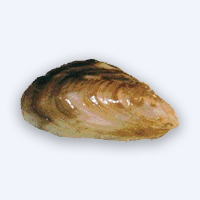
A close relative of the Zebra mussel which already infests Crystal Lake. Like its cousin, it consumes native phytoplankton and clogs lakeshore recreational equipment. More rounded shell and less prominent dark rings than the Quagga. Can grow to 2 inches in length.
New England Mudsnail (Potamopyrgus antipodarum)
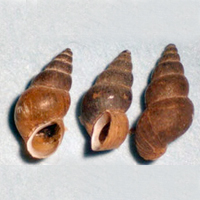
Small dark snails that reproduce rapidly to high densities in many habitats. Their small size makes them difficult to detect when attached to fishing gear or watercraft. They are abundant in the Platte River.
Red Swamp Crayfish (Procambarus clarkii)
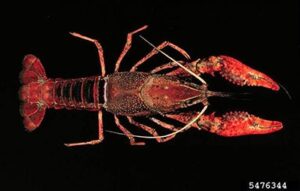
Dark red color with bright red raised spots: look like small lobsters. Length 2.2 - 4.7 inches. Compete aggressively with native crayfish for food and habitat. Introduced by live bait dumping, aquarium trade.
Hydrilla (Hydrilla verticillata)
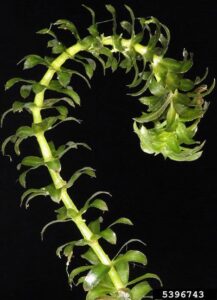
Submerged aquatic plant; green leaves whorled in groups of 4-8. Very slender stems can grow up to 30 feet long. White 3-petaled flowers. Forms dense mats that shade out native vegetation and interferes with recreational activities.
Starry Stonewort (Nitellopsis obtusa)
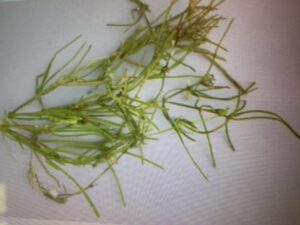
Submerged whorls of 4-6 leaves with blunt tips; can reach up to 33 inches. Forms dense mats that significantly reduce the diversity of other aquatic plants. Mats impede movement of fish, water flow, and recreational activities.